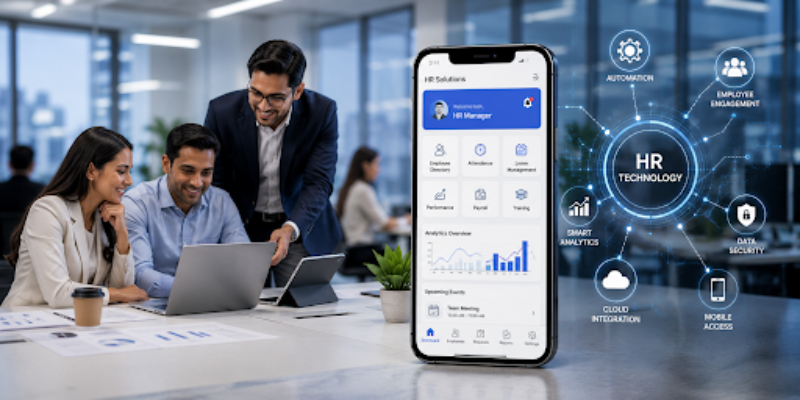
Grace manages HR for a manufacturing company in Nairobi with four hundred and thirty employees across two plants. For the first three years in the role she did it mostly on paper and spreadsheets. Leave requests came in by email. Shift swaps happened through a WhatsApp group that she couldn’t audit. Attendance was tracked on a sign-in sheet that someone had to manually transcribe into a payroll spreadsheet every fortnight. Performance reviews happened once a year, in April, because April was when someone had last updated the review template and it had stuck.
The inefficiency had a cost she could actually calculate: she was spending roughly eighteen hours a week on administrative tasks that produced no value beyond keeping the existing process running. That was almost half her working week. She hired a mobile app development company to build a custom HR platform. The math on that decision was straightforward once she wrote it down.
What she found during the build was that the problems she’d identified upfront were only part of what the platform ended up solving. Here’s what the HR technology transformation actually looked like from inside a mid-sized manufacturing business that wasn’t starting from a sophisticated baseline.
The Attendance Problem Is Bigger Than It Looks
Attendance management sounds administrative and dull. In a manufacturing context, it’s actually the foundation that payroll, shift planning, and compliance reporting all sit on. Get the attendance data wrong and every downstream calculation is wrong.
The traditional sign-in sheet has obvious failure modes: it can be signed by someone else, it has no timestamp precision, and transcription errors compound over time. The biometric fingerprint scanner most manufacturing plants have tried at some point is better but creates a queue at shift start that supervisors hate and workers game by clocking in and then going for tea.
A mobile attendance solution using GPS geofencing and optional NFC tap solves both problems without requiring hardware installation at each entry point. An employee opens the app within the geofence of the plant, taps to clock in, and the system records location, device ID, and timestamp. The NFC option, tapping a cheap passive tag mounted at the entrance, adds a physical confirmation step for contexts where GPS accuracy inside a building is insufficient.
The data this generates is a different quality than what a sign-in sheet produces. Grace can see not just who was present but when they arrived relative to their scheduled shift, what their attendance pattern looks like over the past ninety days, and which departments are running chronic lateness problems that individual manager conversations haven’t resolved. That visibility alone changed how she had conversations with plant supervisors about attendance issues.
Leave Management: The Workflow Nobody Enjoyed
Before the platform, a leave request meant an email to Grace, a manual check of the leave balance in the HR spreadsheet, an approval email back, an update to the shift rota in a separate spreadsheet, and a calendar entry in Grace’s calendar as a reminder to update payroll. Seven steps, three different tools, and a reliable bottleneck whenever Grace was out of the office.
The mobile leave flow is one step for the employee: request type, dates, and an optional note. The app checks the leave balance automatically, shows the employee their current entitlement and what this request would leave them with, and routes to the employee’s direct supervisor for approval. The supervisor approves or declines in the app with a notification arriving in under a minute. The approved leave updates the shift rota and the payroll record simultaneously. Grace gets a summary notification. She’s no longer in the critical path for a routine workflow.
The thing she mentioned most when we spoke was the transparency. Employees used to complain that they didn’t know how many leave days they had left because the HR spreadsheet wasn’t visible to them and Grace was slow to respond when she was busy. The app shows them their balance every time they open it. That one change, information that had always existed becoming visible to the person it concerned, reduced her inbox volume around leave inquiries by roughly sixty percent in the first two months.
Shift Management for Variable Workforce Situations
Manufacturing operations rarely run on a fixed nine-to-five. Grace’s plants run two twelve-hour shifts with weekend rotations, a pool of casual workers who might be needed on short notice, and a mix of permanent and contract employees whose entitlements differ. Managing this on a shared spreadsheet was a coordination problem that created errors weekly.
The shift management module stores the roster pattern for permanent staff, allows supervisors to publish shift schedules two weeks out, and sends employee notifications when their schedule is confirmed or updated. Shift swap requests go through an approval workflow rather than happening informally on WhatsApp: one employee requests a swap, the other confirms availability, the supervisor approves, and the system updates the roster with an audit trail showing who worked when.
The casual worker pool management was the part that needed the most custom thinking. Grace needed to be able to notify a pool of available casual workers about an available shift, see who confirmed availability, and assign in order of some preference criteria (proximity, experience with specific equipment, number of shifts already worked that week to manage overtime). The app sends a push notification to all eligible casual workers, first to confirm gets the shift, and the assignment is logged.
Performance Management That Actually Happens
The once-a-year review in April was symptomatic of a broader problem: performance conversations only happened when a formal process forced them. The plant supervisors weren’t avoiding them out of laziness. They were avoiding the paperwork, the form that had to be printed, filled in, signed, scanned, emailed to Grace, filed, and then summarized into a spreadsheet for the annual report to the board.
A mobile performance module changes the friction calculus. A supervisor who wants to record a positive observation about an employee’s handling of a safety situation can do it in thirty seconds on their phone, standing on the plant floor where it happened. The employee receives the note. It’s recorded in their profile. At review time, both supervisor and employee have a year’s worth of documented observations to discuss rather than relying on whatever either of them happens to remember from the past twelve months.
Pulse surveys, short three-question check-ins sent to employees monthly through the app, give Grace data on how engagement is tracking across departments that her annual engagement survey never could. The annual survey was a lagging indicator: by the time it revealed a problem in a specific department, the problem had been building for months. Monthly pulse data shows trends as they develop.
Payroll Integration and What It Actually Requires
The HR platform doesn’t replace the payroll system. It feeds it. The attendance data, leave records, and shift assignments that the HR app manages flow into the payroll calculation at the end of each pay period. Getting this integration right is where most mid-market HR implementations struggle.
The integration requirements depend heavily on which payroll system is already in place. If the payroll provider has a well-documented API, the integration is a defined engineering task. If it’s a legacy system with no API that requires a CSV import in a specific format, the engineering is simpler but the risk of format errors creating payroll mistakes is real and needs testing against actual payroll data before go-live.
Grace’s payroll system had a basic export-import function. The platform generates a payroll export in the required format at the end of each pay period. It’s not an elegant integration, but it eliminated the manual transcription step that had been producing errors in her previous process, which was the actual problem to solve.
What Changed and What Didn’t
Eighteen months after launch, Grace spends about six hours a week on HR administration that previously took eighteen. The work that used to consume those twelve hours, leave processing, attendance transcription, shift roster updates, ad-hoc email responses to information requests, is now handled by the system. She spends those recovered hours on work she’d never had time to get to: analyzing the attendance and turnover patterns to identify which departments and which supervisor profiles were retaining staff and which weren’t, and bringing those findings to management conversations that previously had no data behind them.
The plant manager told her that the shift swap audit trail had resolved two disputes about who had agreed to work which shift, disputes that in the past would have been unresolvable because nothing was documented. He also said that the supervisors who had initially complained about having to use the app for approvals had stopped complaining after about three weeks, which is roughly how long it takes for a workflow improvement to stop feeling new and start feeling normal.
The things that didn’t change: the pay rates, the leave entitlements, the employment policies. The platform didn’t design a better HR system. It made the existing system run as it was supposed to, consistently and with a data trail that Grace could actually use. That’s usually what good HR technology does in practice. Not transformation through replacement but transformation through finally making the existing rules actually operate.